Posts mit dem Label 20s werden angezeigt. Alle Posts anzeigen

30.11.2012

Fair Isle


Fair Isle is the most remote inhabited island in the United Kingdom. Knitting is an important source of income for the island’s women. They use a traditional technique creating a pattern that is named after the island. It gained a considerable popularity when trendsetter Edward Prince of Wales wore Fair Isle sweater vests in public in 1921 and knitwear with these patterns became a typical satorial appearance of the 1920s and 30s. (More about Fair Isle sweaters can be found here and here.)

As a child I loved the TV series All Creatures Great And Small where Fair Isle sweaters were a common garment of Tristan Farnon. Recently I saw them again watching Brideshead Revisited and fell for them instantly. The supply is modest these days even on the Internet and prices are accordingly high. Luckily I went to Frankfurt last weekend where the beautiful Hackett store had some in stock and I could grab the penultimate Fair Isle tank top. Love it!
***


Fair Isle ist die abgelegenste bewohnte Insel Großbritanniens. Stricken ist eine wichtige Einnahmequelle für die Frauen der Insel. Sie verwenden dabei eine traditionelle Technik und schaffen ein Muster, das nach der Insel benannt ist. Es wurde 1921 besonders populär, als der Trendsetter Edward Prince of Wales Fair Isle Pullover in der Öffentlichkeit trug, und Strickwaren mit diesem Muster wurden zu einer typischen Modeerscheinung der 1920er und 30er Jahre.

Als Kind liebte ich die TV-Serie Der Doktor und das liebe Vieh, wo Fair Isle Pullover das übliche Kleidungsstück von Tristan Farnon waren. Neulich entdeckte ich sie wieder in Wiedersehen in Brideshead und war sofort wieder begeistert. Das Angebot ist heutzutage bescheiden, auch im Internet, und die Preise sind entsprechend hoch. Glücklicherweise war ich am letzten Wochenende in Frankfurt, wo die wunderschöne Filiale von Hackett einige auf Lager hatte und ich den vorletzten Fair Isle-Pullunder ergattern konnte. Ich liebe ihn!


10.07.2012

German Vogue Collection

The joy of the legendary fashion magazine Vogue only lasted briefly in Germany. Up to three editions were published monthly from April 1928 to October 1929. Exemplary in fashion and aesthetics its topics and dresscodes were in line with life on the Berlin boulevards. The original cover illustrations by artists like Pierre Mourgue, Georges Lepape and Pierre Brissaud celebrated the new self-confident women's type in all facets of fashion and in best graphic manner. The New York flapper with bob, cut, cloche, pearl necklace, boa and extra-long cigarette holder was omnipresent. The cover illustrations sprayed elegance and a touch of art déco. At the same time they staged the reduced forms and graphic images of modernity. The individual interaction of typography and illustration made each issue artistically unique. The editions became outstanding examples of its time. With the start of the Great Depression, however, the Roaring Twenties ended and the German Vogue was discontinued after just one and a half years, too. Only many years later, in 1979, it appeared on the market again.
Covers of the original edition are now available at LUMAS'.                    
(Text and images: LUMAS)
 ***
Nur kurz währte zunächst das junge Glück der legendären Modezeitschrift Vogue in Deutschland. Von April 1928 bis Oktober 1929 erschienen monatlich bis zu drei Ausgaben. Modisch und ästhetisch vorbildlich, passten Themen und Dresscodes durchaus zum Leben auf den Berliner Boulevards. Die originalen Titel-Illustrationen etwa von Pierre Mourgue, Georges Lepape und Pierre Brissaud zelebrierten den neuen selbstbewussten Frauentyp in allen modischen Facetten und in bester grafischer Manier. Der New Yorker Flapper mit Bob Cut, Topfhut, Perlenkette, Boa und extralanger Zigarettenspitze war allgegenwärtig. Die Cover versprühten Eleganz und einen Hauch von Art déco. Gleichzeitig setzten sie die reduzierten Formen und grafischen Bildstile der Moderne in Szene. Das individuelle Zusammenspiel von Typografie und bildlicher Darstellung verwandelte jedes Heft in ein gestalterisches Unikat. Die Ausgaben wurden zu herausragenden Zeugnissen ihrer Zeit. Mit Beginn der Weltwirtschaftskrise jedoch endete die Ära der Goldenen Zwanziger, und auch die deutsche Vogue wurde nach nur eineinhalb Jahren eingestellt. Erst viele Jahre später, 1979, erschien sie erneut auf dem Markt.
Cover der Original-Ausgaben sind jetzt in limitierter Version bei LUMAS erhältlich.  
(Text und Bilder: LUMAS)

24.06.2012

Bathroom Beach

After a long search I finally found pictures to complete my bathroom decoration:
A beautiful Lido scene from Georges Barbier together with a cover from a German Vogue's 1929 issue bring a bit of beach feeling to my bathroom.
There is always room for improvement, though: what I am dreaming of is an Art Deco style bathroom...
***
Nach langer Suche habe ich endlich  Bilder gefunden, um meine Badezimmerdekoration zu vervollständigen: Eine wunderschöne Lido-Szene von Georges Barbier bringt zusammen mit dem Titelbild einer deutschen Vogue-Ausgabe von 1929 etwas Strandgefühl in mein Bad.
Es gibt allerdings immer noch Raum für Verbesserungen: ich träume von einem Badezimmer im Art Deco-Stil...


23.05.2012

Great Gatsby

Excitedly looking forward! *** In freudiger Erwartung!

12.04.2012

A Life in Pictures

In der Loge (In the Boxes)
Dodo, born in 1907 in Berlin as Dörte Clara Wolff, enjoyed a care-free upbringing in a wealthy Jewish milieu. Even as a young woman, she possessed an allure over those around her and a nature that was uncompromising and intensely emotional.
Dodo received her formal education at the prestigious Schule Reimann and went on to become a successful costume and fashion illustrator. She reached the peak of her artistic career in the years 1927 to 1929, when she created a string of caricaturally drawn, brightly coloured gouaches for the Berlin-based satirical weekly 'Ulk'. These pictures depicted the mondaine life of the modern urban socialite, as well as the increasing alienation of the sexes. With sharp contours, oscillating between Art Déco and the New Objectivity, Dodo managed to capture the essence of the cosmopolitan lifestyle of the late twenties with which she was so intimately familiar.

The first retrospective in the Art Library Berlin features around 120 of her works from all periods of her life: mondaine fashion illustration, illustrations for 'Ulk', her 'pictures of the unconscious' (created in Zurich in 1933 while undergoing psychoanalysis), illustrations for Jewish magazines and works created in exile in London. A wonderful exhibition worth visiting!  
(Text and Images: Art Library Berlin)
***
Der Windhund (The Greyhound)
Dodo, 1907 in Berlin als Dörte Clara Wolff geboren, sorgenfrei in großbürgerlichen jüdischen Verhältnissen aufgewachsen, entwickelte schon als junge Frau eine attraktive Anziehungskraft und verfügte über ein kompromissloses Wesen mit intensiven Emotionen.
Nach ihrer Ausbildung zur erfolgreichen Kostümzeichnerin und Modegrafikerin an der renommierten Schule Reimann war sie zwischen 1927 und 1929 auf ihrem künstlerischen Höhepunkt: Gouachen in leuchtender Farbigkeit, die für das Berliner Unterhaltungsblatt Ulk entstanden, schildern in karikaturhafter Überzeichnung das mondäne Leben des modernen Großstädters ebenso wie die zunehmende Entfremdung der Geschlechter. Mit scharfen Linienkonturen - zwischen Art Déco und Neuer Sachlichkeit changierend - verstand es Dodo, den ihr selbst geläufigen kosmopolitischen Lebensstil der späten Zwanziger Jahre treffend und entlarvend zu fixieren.

Die erste Werkschau in der Kunstbibliothek Berlin umfasst rund 120 Arbeiten aus allen Lebensphasen: mondäne Modegrafik, Illustrationen für Ulk, die so genannten "unbewussten" Bilder ihrer privaten Turbulenzen während einer 1933 in Zürich durchlebten Psychoanalyse, Illustrationen für jüdische Zeitschriften sowie Arbeiten aus dem Londoner Exil. Eine wunderbare Ausstellung, die den Besuch lohnt!
(Text und Bilder: Kunstbibliothek Berlin)

31.01.2011

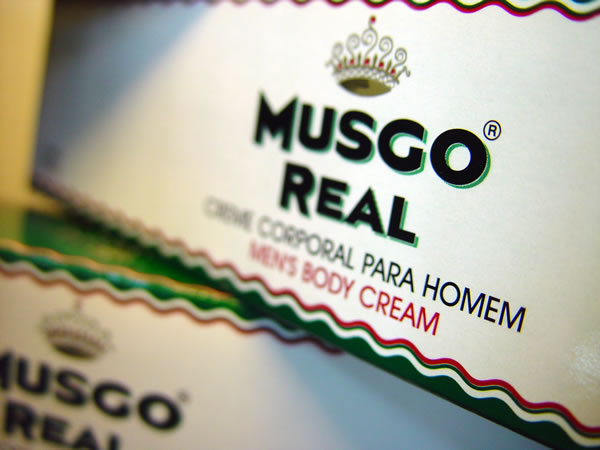
Musgo Real

The first ever Portuguese factory of soaps and perfumes was founded in 1887 in Oporto by Ferdinand Claus and Georges Ph. Schweder, two Germans living in Portugal. By that time, this sort of products were imported and considered a privilege of the wealthiest classes.

In 1903, Schweder left due to health problems and was replaced by Achilles Alves de Brito as the company’s manager, while Willy Thessen – a graduated perfumery chemist – became responsible for the Technical Department. The business grew under the new owners, as soap was becoming more and more popular.

The Germany entrance on the World War I, forced the escape of the two German partners in 1918 and the closing of Claus & Schweder. Achilles de Brito, the Portuguese partner, along with his brother Afonso, created a new company, the ACH. BRITO & CO. Lda. However, Achilles de Brito decided to maintain the Claus Porto brand and, for years, both brands coexisted as umbrella brands, covering a set of product brands. The new company became known for its quality and innovation, particularly in packaging.

Throughout the forties and fifties Ach. Brito conquered the leadership of the domestic market. The company produced for the internal market, especially for the Portuguese colonies, and exported to England and United States of America. From early on, one of Ach. Brito’s main concerns was to have faithful costumers, which led to large investments in the aroma, texture and price of its products. In 1953, the company even created its own lithography, where labels were hand-painted.


In the 1920s the brand Musgo Real was developed - an exceedingly odourous scent which to this day is sold in the beautiful original packing and which I unfortunately not discovered earlier.
Die allererste portugiesische Fabrik für Seifen und Parfüm wurde 1887 in Oporto von Ferdinand Claus und Georges Ph. Schweder, zwei in Portugal lebenden Deutschen, gegründet. Zu jener Zeit wurde diese Art von Produkten importiert und als Privileg der wohlhabenden Schicht angesehen.

1903 verließ Schweder wegen gesundheitlicher Probleme das Unternehmen und wurde von Achilles Alves de Brito als Geschäftsführer ersetzt, während Willy Thessen - ein diplomierter Parfüm-Chemiker - die Verantwortung für die technische Abteilung übernahm. Das Geschäft wuchs unter den neuen Besitzern, denn Seife wurde immer populärer.
 
Der Eintritt Deutschlands in den 1. Weltkrieg führte 1918 zur Flucht der beiden deutschen Partner und zur Schließung von Claus & Schweder. Achilles de Brito, der portugiesische Partner, schuf zusammen mit seinem Bruder Afonso eine neue Firma, CH. BRITO & CO. Achilles de Brito entschloss sich allerdings, die Marke Claus Porto zu erhalten, und so bestanden beide Marken jahrelang als Dachmarken nebeneinander und deckten eine Reihe von Produktmarken ab. Die neue Firma wurde für ihre Qualität und Innovationen bekannt, vor allem bei der Verpackung.
 
Während der vierziger und fünfziger Jahre eroberte Ach. Brito die Führung des inländischen Marktes. Die Firma produzierte für den Binnenmarkt, besonders für die portugiesischen Kolonien, und exportierte nach England und in die USA. Von Anfang an legte Ach. Brito besonderen Wert darauf, treue Kunden zu haben, was zu großen Investitionen in das Aroma, die Zusammensetzung und den Preis der Produkte führte. 1953 schuf die Firma sogar ihre eigene Lithografie, bei der Etiketten handgemalt wurden. 

In den 1920er Jahren wurde die Marke Musgo Real entwickelt - ein äußerst wohlriechender Duft, der bis heute in der wunderschönen Originalverpackung verkauft wird und den ich leider erst vor kurzem entdeckt habe.

24.01.2011

"Go late!"


If I had the choice where to go with a time machine I would travel to the 1920s. I am not sure about the place: Berlin must have been quite a hot spot, but Singapore might be even more tantalizing - Berlin's nightlife plus exotic touch and a motley international society. However, it  would also be very tempting to experience Harlem in it's heyday - the variety of it's nightlife is  very good visible in this wonderful map, first published in Manhattan Magazine (1932). More information about it can be found here.
***
Wenn ich die Wahl hätte, würde ich mit einer Zeitmaschine in die 1920er Jahre reisen. Bezüglich des Ortes bin ich mir nicht sicher: Berlin muss ein ziemlicher Hotspot gewesen sein, aber Singapur wäre vielleicht sogar noch verlockender - Berlins Nachtleben plus exotischem Touch und buntgewürfelter internationaler Gemeinschaft. Es wäre allerdings auch sehr verführerisch, Harlem in seiner Glanzzeit zu erleben - die Vielfältigkeit des Nachtlebens wird in dieser wunderbaren Karte sehr gut sichtbar, die erstmalig 1932 im Manhattan Magazine veröffentlicht wurde. Mehr Infos darüber findet man hier.

30.08.2010

Disch House

The Disch House in Cologne was built between 1928 and 1930 as an "infinite curve" on a tightly dimensioned corner lot in a back then high-density city quarter. Today it contains a department store whose high quality goods are mostly as stylish as this beautiful building.
***
Das Disch-Haus in Köln entstand in den Jahren 1928 bis 1930 als „unendliche Kurve“ auf einem knapp bemessenen Eckgrundstück in einem damals noch eng bebauten Altstadtviertel . Heute beherbergt es ein Kaufhaus, dessen Qualitätswaren meist ebenso stilvoll sind wie dieses wunderschöne Gebäude.

25.08.2010

Detect the Elegance

"My ambition: never copy. Create a new style, bright blazing colours, and detect the elegance in your models."


Tamara de Lempicka, born 1898 in Warsaw, was one of the most famous Art Déco Painter and "the first woman artist to be a glamour star." Her life and works are the epitome of everything I love about the Roaring Twenties - coolness, style, savoir vivre, glamour, beauty, modernity, onset into a new era, the spirit of a new age. Thanks to the virtual world her complete works can now be admired online!
***
"Mein Ziel: Kopiere nie. Schaffe einen neuen Stil, helle leuchtende Farben, und spüre in deinen Modellen die Eleganz auf."

Tamara de Lempicka, 1898 in Warschau geboren, war eine der berühmtesten Art Déco-Malerinnen und "erster Glamour-Star unter den Künstlerinnen." Ihr Leben und Werk sind der Inbegriff alldessen, was ich an den Goldenen Zwanzigern liebe - Coolness, Stil, Lebenskunst, Glamour, Modernität, Aufbruch in eine neue Ära, der Geist eines neuen Zeitalters. Dank der virtuellen Welt kann ihr gesamtes Werk jetzt online bewundert werden!

27.07.2010

Barcelona Pavilion

Although there is a plethora of wonderful buildigs in Barcelona, Mies van der Rohe's German Pavilion of the 1929 International Exhibition is my favourite. Classic modernity and simple yet extravagant beauty - the building spreads a stylish coolness that in my opinion epitomizes the air of the 1920s.
***
Obwohl es eine Unmenge von schönen Gebäuden in Barcelona gibt, ist Mies van der Rohes Deutscher Pavillon der Weltausstellung von 1929 mein Favorit. Klassische Modernität und einfache, aber dennoch extravagante Schönheit - das Gebäude versprüht eine stilvolle Coolness, die meiner Meinung nach das Flair der 1920er Jahre verkörpert.

26.07.2010

Fabian

Fabian - The Story of a Moralis by the German author Erich Kästner is one of my favourite books. The novel is set in the Berlin of the early 1930s. Jakob Fabian, unemployed advertiser, is roaming the city and studying life: boarding rooms, bars, certain ladies and respective establishments, jobless people, love and the mendacity of mankind. In the turbid stream of opportunism and inhumanity, the moralist perishes - and with him the ideals of the Weimar Republic. A brilliant and provocative urban satire which gives a splendid insight into the spirit of an dying era.
***
Fabian - Geschichte eines Moralisten von Erich Kästner ist eines meiner Lieblingsbücher. Der Roman spielt im Berlin der frühen 1930er Jahre. Jakob Fabian, Reklamefachmann ohne Anstellung, durchstreift die Stadt und studiert das Leben: möblierte Zimmer, Bars, gewisse Damen und dazugehörige Etablissements, Arbeitslose, die Liebe und die Verlogenheit der Menschheit. Im trüben Strom von Opportunismus und Unmenschlichkeit geht der Moralist unter - und mit ihm die Ideale der Weimarer Republik. Eine brillante und provokante Großstadtsatire, die einen hervorragenden Einblick in den Geist einer sterbenden Ära gibt.


08.07.2010

Easy Virtue

"The twenties have roared... the thirties have yet to swing" - this tagline was enough to lure me into the (kindly air conditioned) cinema despite the current tropical temperatures. Splendid actors, great setting, witty dialogues and a non-Hollywood but nevertheless somewhow happy ending - an enjoyable film!
***
"Die 'Roaring Twenties' sind vorbei… die 'Swinging Thirties' haben noch nicht begonnen" - diese Kurzbeschreibung reichte, um mich trotz gegenwärtiger tropischer Temperaturen ins (angenehm klimatisierte) Kino zu locken. Glänzende Darsteller, tolle Ausstattung, witzige Dialoge und ein nicht-hollywoodmäßiges Happy End, das trotzdem irgendwie happy war - ein unterhaltsamer Film!


Deutscher Trailer hier...